As the Head of the Design Department, I often see students and even seasoned professionals get completely bogged down in the minutiae of a project. We obsess over individual pixels, singular lines, and isolated colors. But sometimes, the most powerful design isn't about what you put on the page. It's about what you leave out.
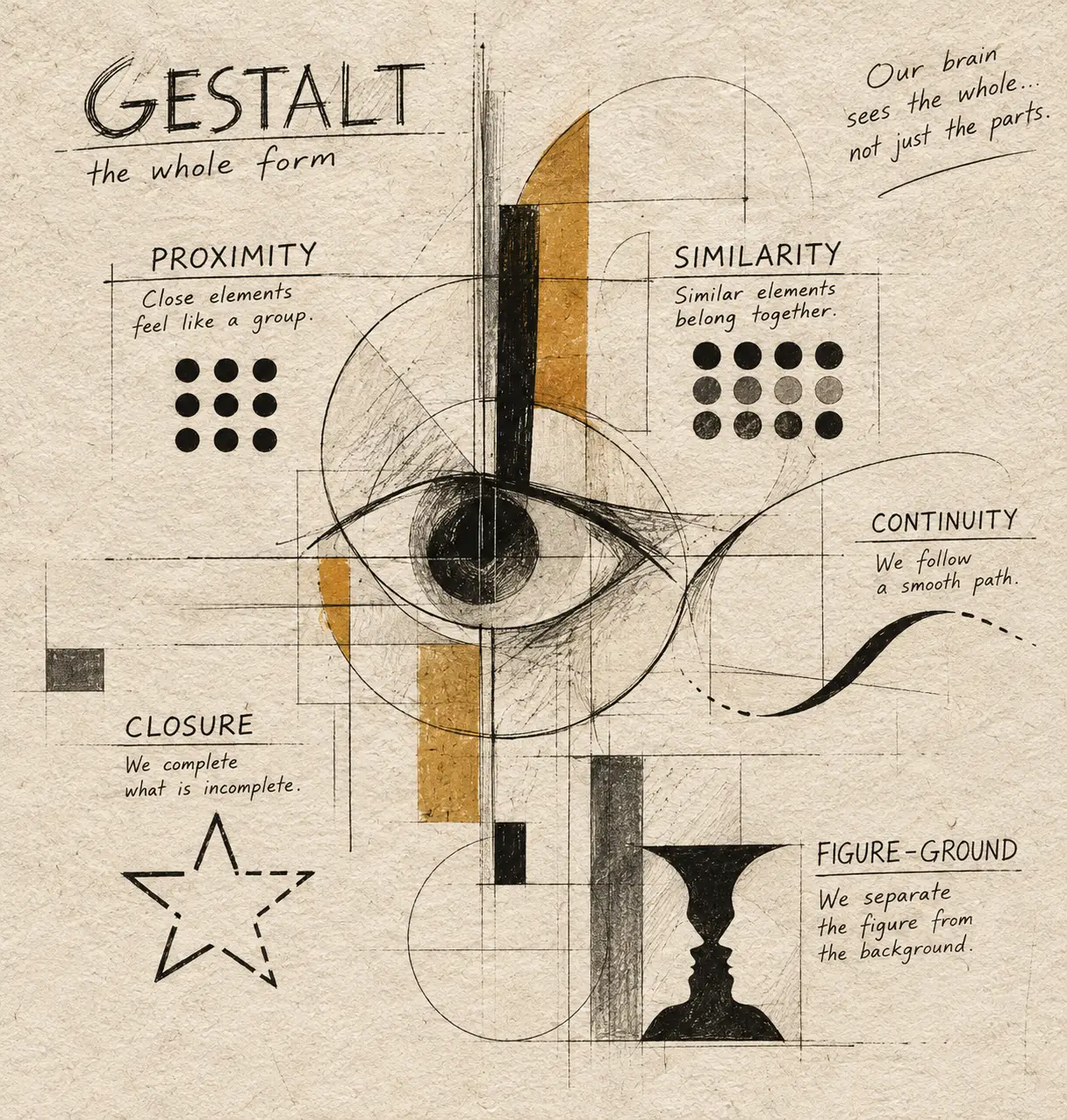
Look at an incomplete drawing of a star, one where the lines don't quite connect. Despite the gaps, you still see a star, don't you? Your brain instinctively fills in the empty spaces.
This isn't magic; it's psychology. Specifically, it's a concept rooted in a German word: Gestalt, which translates to "whole form." Over a hundred years ago, psychologists figured out something crucial for us as creators: the human brain doesn't just see a collection of random parts; it insists on seeing the whole picture first. When we understand this, we realize we can guide how people perceive our work. Let’s look at a few of the core Gestalt principles that we use to silently steer the viewer's eye:
Proximity
Things that are placed close together are naturally perceived as a group. You don't need to draw a box around items to show they are related; simply adjusting the space between them does the trick.
Similarity
Elements that share the same color, shape, or size instantly feel like they belong to the same team. It’s how we create visual consistency without being repetitive.
Continuity
Our eyes love to follow a path. When lines or shapes are arranged in a continuous flow, the eye naturally travels along them, creating a sense of movement and direction in a static image.
Closure
This is the star example. Our brains hate unfinished business. If you present an incomplete shape, the viewer's mind will automatically jump in to finish it. It's a fantastic way to make your design interactive because the viewer has to mentally participate to see the final image.
Figure-Ground
The classic example is the Rubin vase do you see a vase, or do you see two faces? This principle is about how the brain separates the main object (the figure) from its background (the ground). Playing with this can lead to brilliant, dual-meaning logos and graphics.
Design isn't just about making things look pretty. It's about understanding human perception. It’s about knowing how the brain works, and then using that knowledge to communicate faster and more effectively. As I constantly remind our students here at GID: Be fearless, for a design is only as strong as the Designer standing behind it. And part of being a strong designer is knowing when to let the viewer's brain do the heavy lifting.